
How a Help Center Redesign Cut Support Tickets by 34%
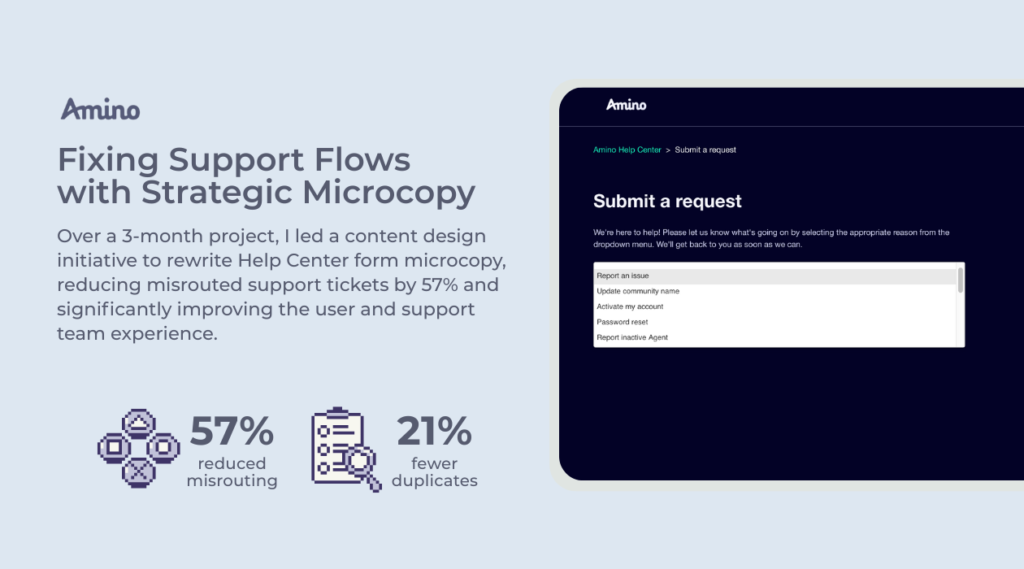
Amino is a social networking app for younger audiences, offering community spaces where users connect over shared interests. Many users submit support requests through Zendesk forms embedded in the Help Center to get help with technical issues and account questions.
The Problem
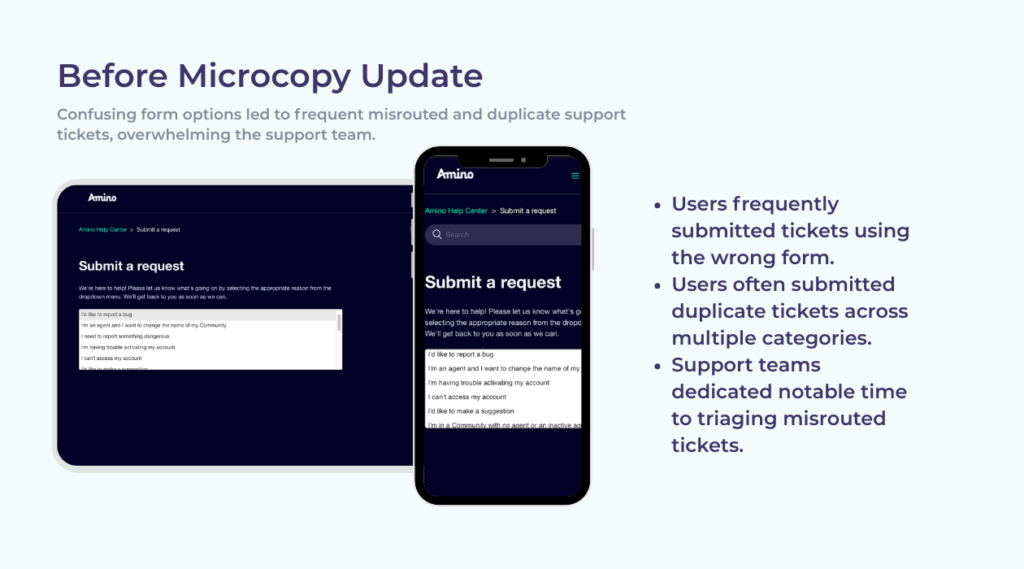
When I began working on Amino’s support experience, I noticed a recurring issue: users were frequently submitting support inquiries through the wrong form. This created two main challenges:
- Users often didn’t receive timely or relevant responses, since some forms triggered only auto-replies or routed to teams that couldn’t resolve their issue
- The support team had to manually reroute tickets, which slowed down resolution times and reduced overall efficiency
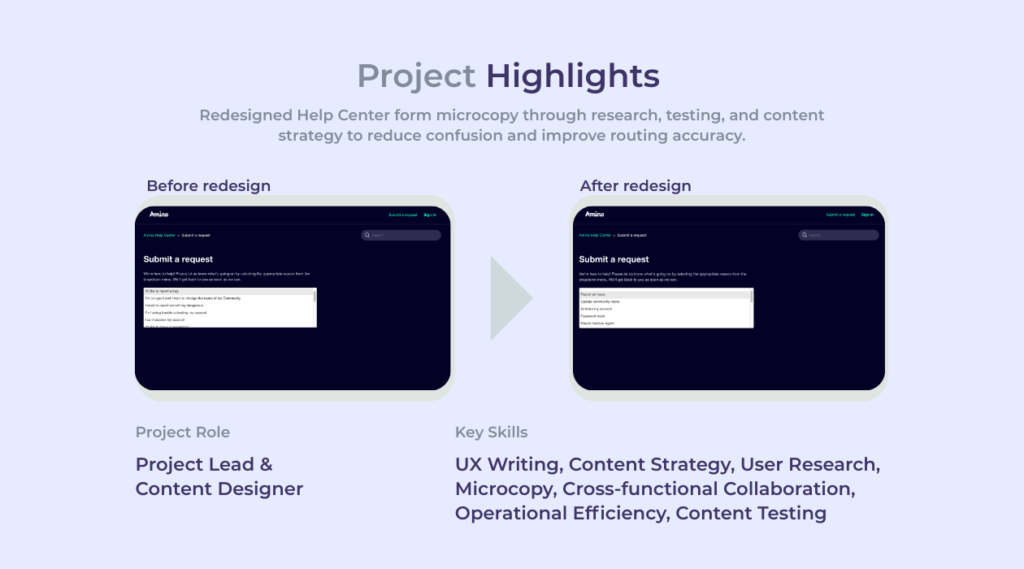
After reviewing the existing Zendesk form setup, I found that much of the confusion stemmed from unclear or overly specific language in the dropdown options. For example, one form was labeled “I’d like to report a bug,” but it was also intended to cover general technical issues. This wasn’t clear to users, so those experiencing problems like app crashes or loading errors often submitted requests to unrelated categories or across multiple forms.
Project Goals
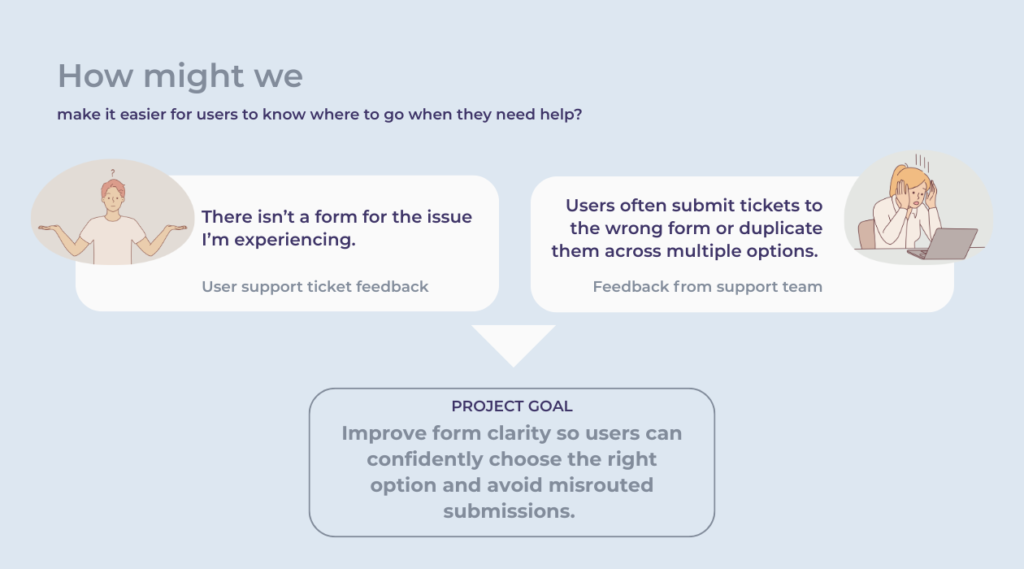
The primary goal was to reduce incorrect ticket submissions by improving the clarity and usability of the Help Center form microcopy. By simplifying language and refining form options, I aimed to:
- Decrease the number of tickets that required manual rerouting
- Help users reach the right support team on the first try, improving response times and resolution accuracy
- Build a more intuitive, self-service experience that reduced friction and confusion for users seeking help
My Role
I led the content design effort from start to finish, which included:
- Analyzing Zendesk ticket data and user feedback to identify pain points
- Conducting remote usability testing with a cohort of Amino users on Discord
- Writing and revising dropdown menu options and form field copy to improve clarity
- Collaborating closely with the Support team to understand workflows and ticket routing processes
- Monitoring post-launch metrics and collecting ongoing user feedback to measure impact and guide refinements
The Process
I started by reviewing ticket data and user feedback to understand where users were getting confused, then updated the form microcopy to better reflect how they described their issues. I worked closely with the Support team, tested the changes with users, and monitored results after launch to make sure the updates were working as intended.
Research & Discovery
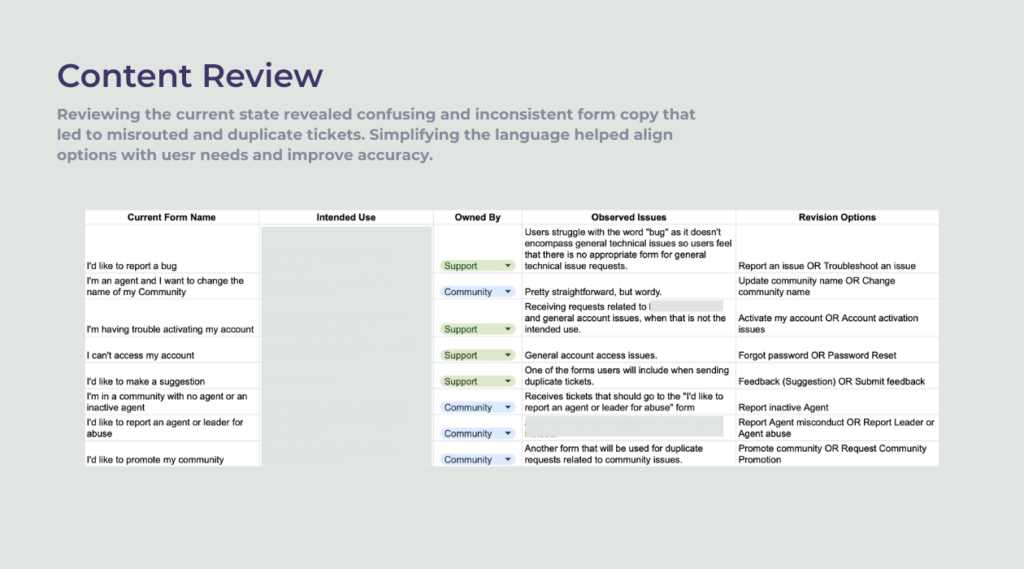
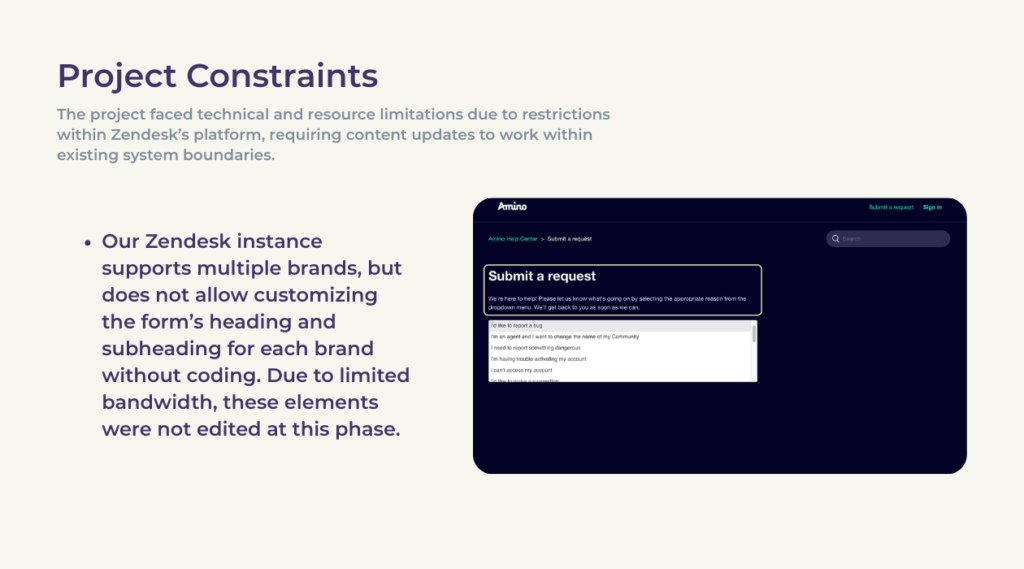
I began by cleaning and categorizing Zendesk ticket data, identifying common patterns of misrouted inquiries. User feedback collected by support agents echoed confusion around the form language, particularly the dropdown menu’s phrasing.
To validate these findings, I conducted remote moderated usability testing with a cohort of Amino users on Discord. This qualitative feedback confirmed that the existing microcopy was often unclear or overly formal, leading users to select incorrect options out of frustration or misunderstanding.
Strategy & Design
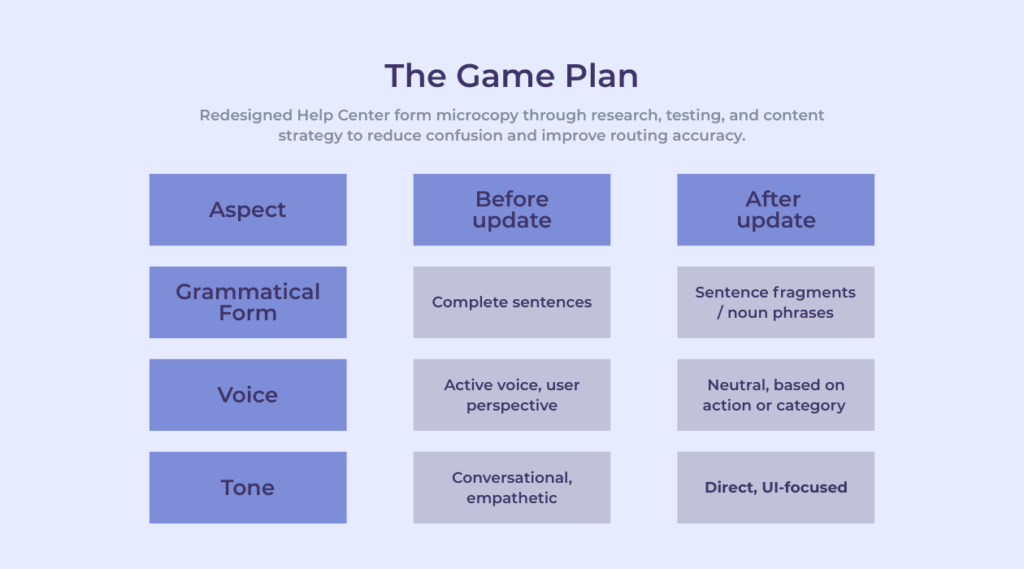
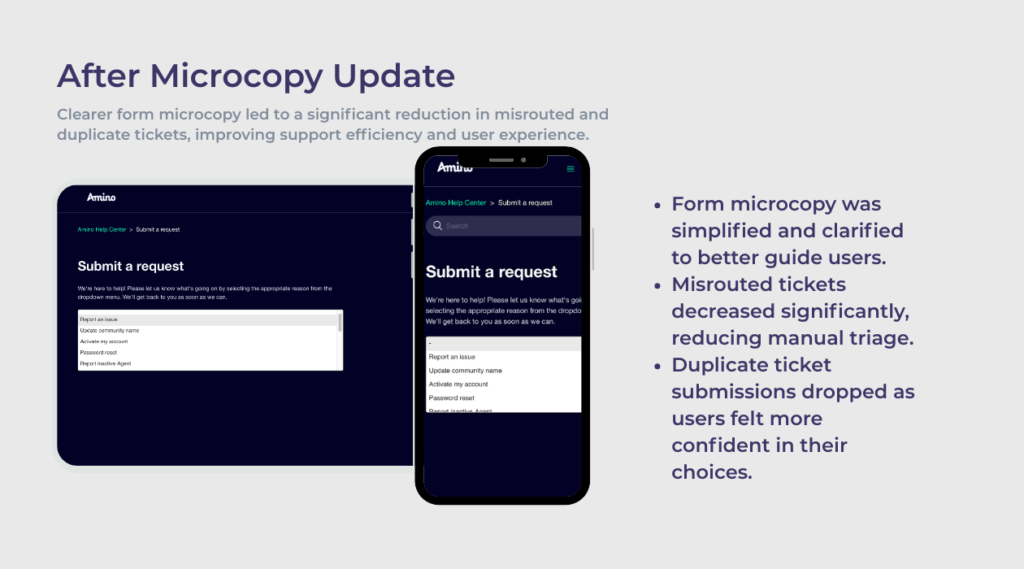
Based on user behavior and platform constraints, I chose to use short, action-oriented fragments in the dropdown menus instead of full sentences. This approach aligned with Amino’s mobile-first usage patterns, multi-language support needs, and limitations of Zendesk’s UI components.
Key strategic decisions included:
- Using shorter phrases for quick scannability, especially on mobile
- Ensuring consistent formatting across dropdown options and screen sizes
- Applying a neutral, system voice appropriate for form-based interactions
- Focusing copy on the user’s intended action or issue
- Choosing language that localized cleanly across Amino’s 7 supported languages
Design & Development
During this phase, I created low- and high-fidelity wireframes in Figma to visualize new layouts and test content hierarchy across key Help Center templates.
All support articles were rewritten with a focus on clarity, consistency, and actionable language, simplifying technical jargon and improving scannability. Mobile-first optimization was a priority, with shorter paragraphs, more visual breaks, and testing on smaller screens to ensure readability.
We opted for a pre-built Zendesk Help Center theme to streamline development, and I customized key elements to better align with Kik’s brand and UX goals.
I worked closely with product and engineering to ensure content was accurate, technically sound, and aligned with the platform experience, while also collaborating on the design of category pages and search functionality.
Refinement & Testing
After implementation, I monitored Zendesk data to measure impact. The result was a 57% reduction in ticket re-routing, which significantly decreased manual reassignment workload for the support team. Additionally, duplicate ticket submission dropped by 21%, further improving operational efficiency.
I also collected user feedback post-launch through ongoing Discord engagement and internal support channels, which indicated less confusion and frustration around the form.
While I did not iterate the copy further, this success confirmed the power of targeted microcopy improvements.
Implementation & Launch
Working closely with Support and Product teams, I launched the updated forms seamlessly within the existing Zendesk Help Center, ensuring changes integrated cleanly with current workflows despite platform constraints.
To support sustainability, I documented the new copy standards and shared guidance with the Support team to maintain alignment on categories and routing logic.
Post-launch, I monitored form performance and user feedback to validate impact. The low-resource, high-impact nature of this change showed how content design can drive both user clarity and internal efficiency.
Final Thoughts
This project was a clear reminder that even small content changes can produce outsized effects on user experience and business efficiency.
By deeply understanding users’ language and pain points, and translating those insights into simple, effective microcopy, ticket accuracy was dramatically improved and the workload for Amino’s support team was significantly reduced.
If given more time and resources, I would pursue further A/B testing and explore visual UX enhancements to complement the copy, but platform limitations, lack of coding capacity during this iteration, and technical constraints prevented these efforts.
Key Metrics
- 57% reduction in ticket re-routing following copy updates
- 21% decrease in duplicate ticket submissions
- Noticeable improvement in user satisfaction based on support feedback and Discord testing
- Faster resolution times thanks to more accurate ticket routing